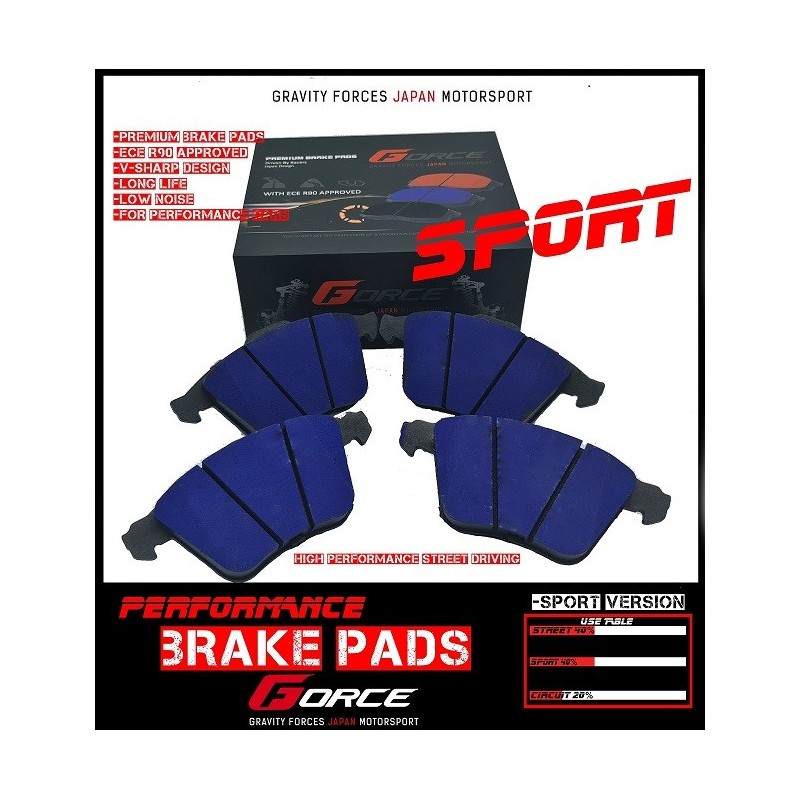
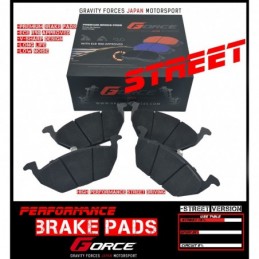
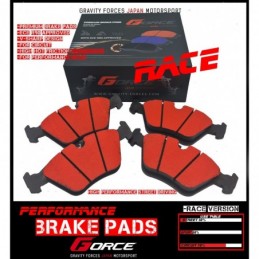
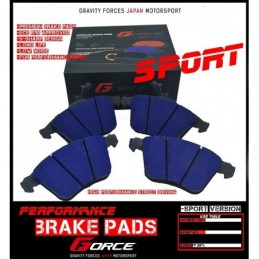
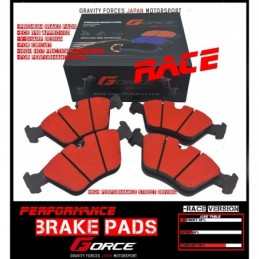
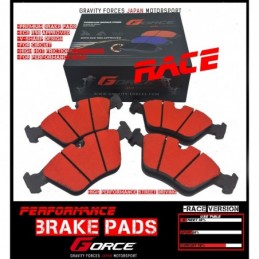
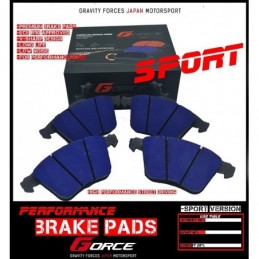
Gforce brake pads have the ECE-R90 approval according to the request of European regulations. (for models manufactured after 1999) The identification number ECE-R90 is visible.
COMPOUNDS AVAILABLE

Designed for OEM applications.
With an excellent behavior both at high thermal levels and cold. Excellent resilience in wet situations, high resistance to fading and consistent pedal feel, all of which contribute to the high requirements, safety and confidence with the highest performance level.
Temperature: 0-450ºc
Friction 0.32-0.40u
-Without noise.
-Long duration.
-Good cold bite.
2-SP: Sport range.

Designed for normal road use and demanding sporty driving. Specifically made from soft racing and circuit material.
-Temperature: 20-550ºc
-Friction 0.40-0.45u
-Medium duration.
-Good cold bite.
-Low noise.
3-R Racing Range

Designed for competitions of any kind, with multiple applications for touring cars, rallies and formulas.
-Temperature: 100-700ºC
-Average friction 0.48
-Short life.
-Good bite with previous warm-up.
-Medium noise.
-Advisable for professional use only.
Precision engineering
V-SHARP DESIGN
Our innovative V-SHARP refrigeration system is designed to maintain an optimal temperature during the most demanding conditions, adapting the temperature curve to the compound you have chosen. In addition, VSHARP technology provides a good bite both hot and cold.

All backplates on our pads are made from high-tensile steel, which means minimal distortion when subjected to the high clamping forces common in motorsport use.
The pads are manufactured to maintain tight tolerances on pad and backplate dimensions, including: flatness, parallelism, and overall thickness.
This results in a rapid and uniform transmission of pressure from the brake system to the pads.
Thermal underlayer:
Unlike many competitive products, most GFORCE brake pads incorporate a thermal underlayment between the backing plate and the friction material.
This reduces the operating temperature of the brake caliper by up to 80 ° C and significantly reduces the risk of boiling the brake fluid, causing a "spongy" feeling on the pedal.
Friendly discs:
Unlike many competitive products, GFORCE pads are kind to brake discs.
GFORCE pads are developed to optimize pad and disc life. Our philosophy is not to increase the life of the pad with the victim of excessive disc wear.
High controllability:
All GFORCE brake pads are designed to operate with a relatively constant coefficient of friction (mu) over a wide range of vehicle temperatures, pressures and speeds.

SILOXANE
In the world of brakes, "Ceramic" is a word that is heard a lot. However, "Ceramic" can simply indicate that the product contains something, anything, that is not "organic". Organic means a substance whose molecular structure is based primarily on carbon. However, for an engineer to understand a material such as ceramic, he or she knows that this must mean that the core that defines performance must be non-organic. In the case of a friction material, this is the resin, the glue that holds the pad together; the matrix that holds the other components in place, allowing them to do their job. For more than 100 years, this work has been and continues to be performed on brake pads almost exclusively by a phenolic resin. A very durable and versatile binder, but decidedly an "organic" material. The appeal of a non-organic brake pad is simple: phenolic resins begin to break down at temperatures above 300-400 ° C. On a race track, where these temperatures would be considered an operating minimum is bad news. It means that the pads wear more as the carbonaceous material breaks down, the pedal becomes spongy as the pad loses stiffness, and the brake fades as gaseous decay products try to escape at the disc / disc interface. tablet. The problem is, no one had found a viable alternative to the phenolic-based brake pad, other than sintered metal compounds. The latter materials work well in motorcycle racing, but the much higher weight of a car makes heat transfer to the caliper an almost insurmountable problem in auto racing. Also, as it is essentially an incompressible block of metal, sintered pads are often considered to lack the "feel" a racing driver requires, being little more than an on / off switch for the brake.However, in -R COMPOSITE RACING, you can offer a true "ceramic" race brake pad. The resin binding system that replaces traditional phenolic is described as a "siloxane". In simple terms, this means that the 3D molecular lattice that holds the chip together is made up of chains of silicon rather than carbon atoms. These are impervious to temperature. Additionally, cured (ie "set" during the manufacturing process) resin, which is a hard, abrasive ceramic, has friction enhancing properties.
So there is a double benefit. Phenolic carbon does not break down, so wear is low and an abrasive substructure that keeps the coefficient of friction (?) High! -SP COMPOUND SPORT is recommended for FIA GT, Touring Car, Formula Cars, Group N and Stock Car. -R COMPOSITE RACING is used in rally and speed racing applications, although drivers who appreciate its high friction have also been using it for passenger car and N-group applications. Both are characterized by a long service life, a high? and a firm pedal in all conditions, but the torque profile of -SP COMPOUND SPORT during a brake application is flat, while that of -R COMPOUND RACING increases, making them complementary compounds, depending on the type of vehicle and the driver's preference.

While noise, vibration, and harshness problems (associated problems known in the industry by the general abbreviation NVH) have become of utmost importance to on-road vehicle braking, they are of little concern in racing. Generally speaking, the performance requirements on the track are as follows:
-High friction. Very high decelerations are required, often from systems that are not servo assisted. The combination of downforce and big sticky tires means that the limiting factor in braking is often the force applied through the driver's foot rather than road / tire grip. The requirement for maximum braking torque of available muscle power means that materials with a high coefficient of friction are preferred - in other words, those materials that translate the highest possible percentage of the applied force in decelerating the vehicle. Fade is the term used for a decrease in friction performance at high temperatures. High vehicle speeds, high decelerations, frequent brake applications and limited cooling (air conduction creates drag) means that the discs and pads get very hot, up to 900 ° C. However, I must maintain it even in these extreme conditions.
Low compressibility of the tablet. This results in shorter pedal travel, one of the key driver requirements. Ideally, the compressibility of the pad will be the same at all temperatures and will not change during a run. The "correct" friction story. This is sometimes called "stop shape" or "time history" and refers to how the coefficient of friction varies through the application of a brake. As such, it is the response of the braking system to increasing temperature as speed decreases. This is as close as possible to an objective description of the hard-to-define brake "feel." Generally speaking, higher downforce car drivers prefer a flat response (this is because the last thing a driver needs is to increase friction at the apex of the curve, just as downforce is reduced due to its lower speed: result; wheel lock!) while vehicles with less downforce often prefer increased friction through stop. -SP COMPOSITE SPORT is an example of a material with a flatter butt shape, while -R COMPOSITE RACING has a rising torque output. How quickly the brake responds to the driver's pedal. Almost exclusively, the faster the better. Pad and disc of life. Not always important, but vital in endurance racing, where the number of pit stops must be minimized and, not least, economically, as fewer disc and pad changes mean fewer disc and pad purchases. New technology results in a constant braking sensation for the driver, which means that braking torque is a linear response to pedal pressure.
Wide Range of Material and Accessory Options GFORCE has one of the widest range of pad shapes on the racing / performance brake pad market.
This range of accessories is available with the required compound option, which means there is always a solution for your needs.